Research and career exploration

Do you want to make change in your career or looking to change jobs but don’t know how or where to start from?

The following 5 steps can help you achieve results:

  1. Define your purpose: what do you want to achieve or why do you want career change? Is it because of poor pay, are you looking for job security or a job that is flexible? Napoleon Hill says, ‘definiteness of purpose is the starting point of all achievements.’’ So, be definite in what you want to achieve if you are considering career Change.
  2. Research and familiarise yourself with the job market: What job opportunities are available in the market that interest you? Now days everything is online, research jobs on job boards that advertise jobs. In Australia people research Seek, Ethical jobs,
  • Carry out self- assessment: what are your strengths and weaknesses? What skill, knowledge and experiences do you have that can match the required skills and knowledge in the job you are seeking to go into? Do your core values align with the career or job you are seeking to be in?  If you have skills shortage, what can you do to acquire those skills and suitable for that desired career or job? People volunteer, others undergo training. Compare job adverts that suits your skills and knowledge. Which of them provides you what you want. Read industry blogs, attend webinars, and follow professionals in the industries of interest. If you can speak with them, the better
  • Draw up career goals; What are your long- and short-term goals: where do you want to see yourself in the next 5 or 10 years for example. Do you want to be a manager, CEO, have some investments through savings from the pay you will be getting, that is not afforded to you by your current Job?3
  • Draft a strong resume and cover letter, then start applying for jobs. You can follow up with a phone call to show interest. Networking also can help. Develop online presence by posting your resume online in online spaces like LinkedIn or Seek if you are in Australia among other job sites.

“Remember, the creaky door, gets oiled.”

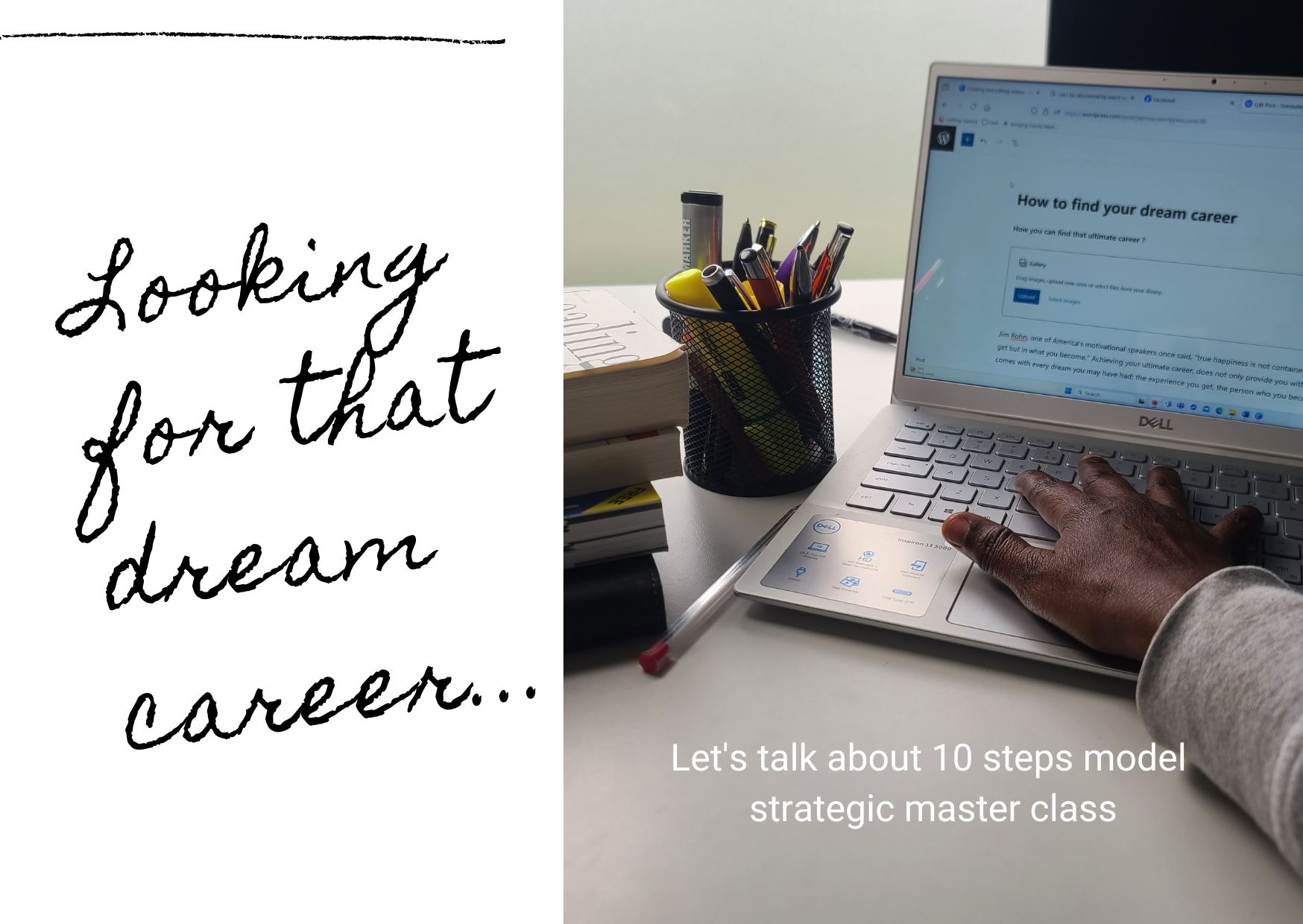
Finding your ultimate dream career

Finding the perfect career.

Jim Rohn, one of America’s motivational speakers once said, “true happiness is not contained in  what you get but in what you become.” Achieving your ultimate career, does not only provide you with a job role it comes with every dream you may have had; the experience you get, the person who you become and the remunerate on that goes with the role.  Did you know that you are in a role at work due to the skills you provide? That, you are being paid due to the value addition that your skills provide to your employer.

Your skills are valuable and irreplaceable because we are unique individuals with unique skills that add value to every work we do. Our skills can never be quantified. They can only be appreciated in terms of salary and other perks associated with the role. So, next time you are negotiating for a pay rise, a new role or seeking new employment, value your skills.

The major key to your career success is you.

Below are some of the most powerful master class strategies to use when seeking your new career.

Before switching careers, or your last job may have terminated and you feel ready to explore the next career role, use the following strategies as your guide.

Self-Assessment: identify your strengths and skills against the requirements of the role you are seeking. For example, are you a good listener, empathetic, can you work well within a team and autonomously.  What are you passionate about and enjoy doing?

  • Carry out research on the industry you want to start your next career in. Explore expectations and check if your skills align with their requirements. You can make calls to find more industry information. Read websites or /and industry blogs.  If you find that the skills you have don’t align, identify the gaps and work on them.
  • Network, network, and network. Attend industry workshops and other events. Networks can help you find hidden markets. Some companies, jobs are filled through referrals, as such networking can help you tap into such markets.
  • Develop your personal branding such as an online presence like linked in where you can upload your resume and employers can find your skills.

Connect to our 10 -Model strategic Master class for a detailed step by step support towards realizing your dream career.

Welcome to growth mindset

Welcome to a world of endless possibilities, where the only thing standing between you and success is the figment of your imaginations. A world abundant with ideas to inform your career journey. Enjoy every moment of thought provoking ideas and strategies that can propel you to immense career growth, where every moment is an opportunity to create a world of abundance .

Explore your path to success today: Start Your Career Coaching Journey Today with Chebo Sembolei!

What people are saying

Rating: 5 out of 5.

“I had the pleasure of working with [Coach’s Name] from [Coaching Company], and I couldn’t be happier with the results. Their deep understanding of career development and insightful guidance helped me navigate a challenging career transition with confidence and clarity.”

Tom S.

Rating: 5 out of 5.

“I highly recommend [Coach’s Name] and [Coaching Company] to anyone looking to take their career to the next level. Thank you for your expertise and support!”

Liz S.

Rating: 5 out of 5.

“From crafting a compelling resume to honing my interview skills, every session was tailored to my needs and goals. The practical advice and encouragement I received were invaluable in landing my dream job.”

Mike A.

Rating: 5 out of 5.

“Thanks to the guidance and encouragement I received, I’ve not only secured a new job but also gained confidence in navigating future career challenges. I highly recommend [Coaching Company] to anyone seeking professional guidance and support. It’s truly a game-changer!”

Mike A.

Monday – Friday, 7am – 4pm
Melbourne, Australia
Call us on : (123) 456-7890

What is Mindset coaching?

Mindset Coaching: It is organized method where people work with a coach to learn way to change their thought processes, challenge their belief system like negative opinions and beliefs that hold you back, build in new intellectual skills. As a result, build new perspectives, create better outcomes for themselves both professionally and in personal life.   In a nutshell, positive mindset helps individuals develop productive positive thinking.

Key components that we use for Mindset Coaching.

  1. Goal setting: defining clear, achievable goals that will help you in your growth and development.
  2. Self- awareness: Mind set coach will work with you to identify your strengths, weaknesses and triggers that keep you from progress. Coaching skills will also support you in reflecting on your past experiences and behavior with the aim of using them as a springboard in your growth.
  3. Positive thinking: Coaches work to support you in a way that encourages positive outlook by teaching you how to use such skills as affirmations and visualization techniques.
  • Growth mindset: This is working with you in learning and developing your mindset through using your innate abilities whilst fostering resilience and perseverance. Such innate skills include: Intelligence, creativity, empathy, conscientiousness, emotional stability, creativity, natural talent
  • Emotional regulation: Coaching practice will help you find ways and strategies that can help you to effectively manage your emotions. Will provide you with strategies for stress management and bouncing back from a setback.
  • Behavioral change:  Mindset coaching practice will bestow you with the ability to identify and manage limiting beliefs and habits.
  • Accountability: Whilst working a coach, you will be kept accountable to the goals that you have set yourself to do.  Your coach I will do this by having regular checks to monitor your progress. Your coach will provide you with regular performance feedback.
  • Motivation and encouragement:  Your coach will work with you to keep you motivated through positive reinforcements. Will work with you to celebrate achievements and progress.
  • Skill development:  whilst working with mindset coach, they will help you enhance specific skills like communication, time management and problem- solving.  To the best of my ability, I will provide you with resources and tools for continuous improvement.
  • Mindfulness and well- being In mindset coaching practice, strategies like meditation and mindfulness will be incorporated.

    Embrace the journey within

    Bailey & Rehman 2022 research in Harvard Business, defines self-reflection as being candid with oneself by looking back at defining moments in our lives and examining what worked during those moments, what didn’t work, and how we can do it better next time if improvement is required.

    It is the process of introspectively examining our thoughts, feelings, actions, and motivations in life.

    Self-reflect involves looking back at event/situations in our lives that we found tough, frustrating, or difficult and asking ourselves questions about that situation.

    Self- reflection helps us to scrutinize the situation and learn from it; you look back at your actions of the day and learn from it.

    Case scenario:

    Me; today I was frustrated, and my day was ruined because I couldn’t get to work on time due to school morning traffic.

    Self-reflection: what is the issue- Frustration and a ruined day. What happened? Arrived at work late due to school morning traffic. What would you do differently next time? Get up early to avoid the morning traffic jam.

    Our goals reflect our values system. Our values are the bearings that keep us linked to our purpose in life, be it at work or in our daily lives. We therefore get frustrated when these values are not met but looking beyond our frustration at situation and finding solutions helps us deal with circumstance and forge our way forward in growth.

    Self-reflection is a component of personal development and self-awareness, allowing us to gain deeper understanding into our individuality and our behavior.

    Aspects of Self -reflection.

    1. Understanding emotions:
    2. Self-reflection helps us identify our emotions and their triggers.
    3. Helps us recognize patterns in our emotional responses.
    4. Evaluating our actions and behavior
    5. Self-reflection helps assess our actions and their consequences.
    6. It helps us analyze how our behavior align with our values and goals.
    7. Identifying strengths and weaknesses:
    8. Self-reflection helps us recognize our strengths and areas for improvement.
    9. It also helps us leverage our strengths and address our weaknesses.
    10. Clarifying values and beliefs:
    11. Self-reflection helps us understand our core values and beliefs.
    12. It helps us understand how situations cans influence our actions and decisions.
    13. Setting goals and objectives:
    14. Reflecting on our past actions and setbacks helps us set goals and objectives.
    15. Self- reflection helps us set realistic and meaningful goals for both personal and professional growth.

    When we keep to self-reflection and make it a habit, we can benefit from the following:

    • Increase our self-awareness, improve our self-understanding and personal growth.
    • Helps us improve on our emotional intelligence through managing our emotions more effectively and enhance our relationship with others.
    • Our problem solving skills improve, we grow in critical thinking towards our actions resulting in us developing the ability to approach problem solving skills in different perspectives.
    • Self-reflection facilitates continuous learning and development, professionally and personally.
    • It promotes mental health by reducing stress and increasing our sense of control and purpose.

    How to practice self-reflection:

    Journaling: This is regular documentation of our thoughts and experiences. You can also use prompts to guide our reflection for example asking yourself “what did I learn today, or how did I handle a challenging situation?’

    Use of meditation and mindfulness technique: Practice mindfulness to remain present and be aware of your thoughts and emotions. It helps us reduce anxiety and have control.

    Seek feedback from others to gain different perspectives about ourselves. Reflect on the feedback to understand how others perceive you and you improve from the feedback given.

    Regular reviews like monthly, weekly depending. This will help you track your progress towards goals and plans as needed.

    Key to successful self-reflection:

    • Be honest with yourself about your thoughts, feelings, and behavior.
    • Be patient with yourself because the progress of self-reflection is gradual and takes time.
    • During reflections find a quiet and safe place where you can reflect without destruction
    • Don’t be hard on yourself. Be compassionate and treat yourself with kindness and understanding

    Conclusion:

    Incorporating self-reflection in our daily life can significantly improve our self-awareness, help us asses our actions and their consequences and analyze how our behavior aligns with our values, goals and those of others.

    LIFE COACHING EXPLAINED

    If you have been wondering what life coaching is, here is the answer. Imagine a situation where you felt stuck not knowing where or how to start something say a business project that you dearly want to do. Then, some one comes along and gives you some suggestions on how to go about it. You get the answers and ideas you were looking for. You put the ideas into action and your business is born.

    Another example could be, if you have been struggling with weight loss. Your friend or someone at the gym gives you an idea about a successful weight loss program to combine it with your gym training. You try it. Three months down the line you starting seeing results. Then you realize how close the answer to your situation was.

    Life coaching therefore is a technique that supports people explore their current situations, intentions, aspirations and find answers that help them resolve their identified situations.

    It is a means of facilitating personal development through an exploration and challenging current beliefs, practices, and situations in an individual’s life.

    It is about exploring that individual map, that people create in their lives to inform their way daily life activities. Life coaching examines the importance and meanings that people give to various events in their lives as well as how these events affect their quality of life.

    Life coaching is client directed with professional life coaches using person centered and strength-based approaches to help clients achieve goals.

    What do life coaches do?

    Life coaches help clients achieve goals in their lives by helping them resolve issues that have been keeping them from progressing. The process pays attention to where client is at present and where they want to be in the future. For example a business person who presently feels that they are not making money as they should and would like to increase their sales. A sales coach will work with them to explore ways in which the client can find answers to increase their sales.

    A brief history of life coaching

    Life coaching is believed to have originated from America in late 1980s by a man named Thomas Leornard. He believed people were not broken but were full of potential and had the possibility for personal transformation. Life coaching then bridged the gap between psychology and psychoanalysis.

    Life coaching is not therapy and does not treat mental health issues or prescribe therapies.

    What is the difference between Life Coaching and therapy:

    Therapy/counseling: Patients have past trauma or incidences to deal with. Clients of coaching typically have not experienced any form of trauma in the past.

    Therapists and counselors examine a client’s past to find solutions for present situations. Coaching clients focus on the present to improve on their future.

    Therapist and counselors focus on diagnosing mental health concerns that people experience. Coaching does not. A coach once identified, a life coach can refer situations/cases as needed.

    Therapist/counselors; prescribe therapies or some medication for treatment whereas a typical Life Coach do not prescribe therapies.

    Mentoring:

    Mentors focus specific jobs, tasks pr processes. Life Coaching relatively uses holistic approach to client situations.

    They are more of relationship focused form of a guidance whereas coaching is not relational but professionally done.

    Mentors are more of experts in a certain field, and they work like teaching. Coaching is facilitated, does not teach but guide clients into exploring and resolving their own issues.

    Types of coaching.

    There are various types of life coaching. Life coaching include Mindset coaching, Career Coaching, Health coaching, communication coaching, relationship coaching among many more.

    Let us look at Mindset Coaching

    Mindset coaching help clients challenge own opinions and beliefs that hold them back from progress.

    This is an area that I have skill, experience, and knowledge in. In my positive mindset practice, I propose and encourage three things, that I have used and have been successful for me:

    1. Self-reflection: This is about taking time to intensely think and assess your thoughts, beliefs, desires, motivation, and view about life. What are your feelings about your current situation? It is about thinking about your feeling and asking yourself such questions as, why am I this way? What are my values, believes and attitudes towards the world around me?
    • Self-acceptance: It about asking deep self-discovery questions. Who really are you? Do your belief in the person you currently are?  If not, what can you do to change or improve on that is keeping you from progress or do you just want to keep things at status quo?
    • Self-actualization: Once you have done self-reflection, arrived at self-acceptance, you will realize that self-actualization is key. It is about celebrating your achievements. A place of celebrating your personal potential. 

    Are you feeling stuck or feeling disappointed in your current situation, want to explore yourself further or want to change direction in your life or even just wanting to make changes to the situation? You are at the right place. I use person centred and strength based coaching practice where I help you develop ways to change the course of your situation through helping you to challenge your beliefs, build new mental skills and create good outcomes for yourself.

    Just like life, we are unique and individual in who we are. People are in various stages that they need change in their lives.

     Chebo Positive Mindset Coaching is here to support you in every way that you want your life to take. It can be change in your professional or personal lives. As a positive mindset, I help people develop and keep a productive thinking.

    It is a person centred and strength based coaching practice where I help you develop ways to change the course of your thinking, support you to challenge your current beliefs, build new mental skills and create good outcomes for yourself. It can be in your professional or personal life. As a positive Mindset coach, I will work with you to reinforce positive thoughts that foster growth.

    What is self-acceptance mindset?

    The opposite of self-acceptance is self-rejection, Lack of self-acceptance makes us vulnerable to criticism. It holds us back in almost every aspect of outlives.

    Whereas people with high self-acceptance are more likely to be tolerant to criticism and always continue to improve in aspects of their lives.

    So, what is self- acceptance and why are some people more self-accepting than others?

    Self-acceptance: It is accepting ourselves as who we really are, we are regardless of our flaws. It means deeply and completely accepting ourselves unconditionally and without doubt or exception.

    why are some people more self-accepting than others?

    People vary when it comes to self-acceptance. Some are more self-accepting while other people struggle. Research puts this to a person’s psychological, social, and biological factors.

    Research states that people who have been brought in a more caring and valuing environment are more likely to adopt a higher self-acceptance ability than those people brought up under unstable parental environment. They are more likely to withstand external criticism and judgement.

    Our society also play a role in individual self-acceptance. Research indicate that people brought under cultures that give emphasis to individuality and self- expression are more likely to accept themselves compared to those whose cultures and norms promoted conformity.

    I also strongly belief that we have innate resilience to overcome our situations in the face of  strong normative cultures or low supportive relationships. I belief that, some situations can change our life trajectories by strengthening our self determination through positive happenings.

    A case scenario-true story: When I was young, about 15 years about to join high school, my father could not afford to pay for my school fees. I had to work at my stepbrother’s house looking after his children during school holidays so that he can pay my schools fees. Although my brother then was working in a prestigious government office, I reported to school every opening day with little. I used to tell myself that maybe my brother didn’t have enough money to cover both my school fees and buying me luxurious things like biscuits and dry food that other children brought with them to school.

    I always dreaded school opening days. It made me feel ashamed of myself because other children did not belief me and called me a liar when told them that I lived with my brother in Nairobi. I looked more of a child from the remotest part of Kenya not one from the capital city of Kenya, and not even that one to be associated with my then popular stepbrother. Nobody believed me when I said I was a stepsister of my brother. He was well known and worked in one of the powerful government offices then. Children said that I was a cheat, an imposter, or a wannabe.

    I didn’t have pocket money, had one pair of bedding. My school was in an area where the weather was always cold and wet. When it rained, other children from Nairobi had raincoats, hot water bottles and umbrellas, I doubled up my school cardigan and braced the cold. When other children were visited during mid term visits, no one came to see me.

    I didn’t have many friends to hang out with except for my one friend Vivian who stood by me. I spent most of my time reading and threw my weight behind my studies. When I topped in my class one time, I got motivated. It lifted my self-esteem. Children started to respect me. With time, I accepted myself, my situation. I told myself that my studies will get me where I want to be. I believed that after school, I will get a job, earn salary, and live the life I want.

    I appreciated my brother’s ability to pay for my school fees. I visualize myself speaking in boardroom spaces, influencing policies that provide for poor families. I developed a thick skin against ridicule and bullying at school. Today, looking back, I am grateful for accepting who I am. If I had accepted self-doubt, I would not be where I am today. THE POWER OF SELF-ACCEPTANCE IS HUGE!
    TRUE LOVE CAN NEVER BE FOUND

    Julia returned to the kitchen and carefully placed the plastic bags on the kitchen counter.

    ‘Darling, you did lots of shopping today: vegetables, fruits, canned food, bread and even tomato sauce.’ She counted the items excitedly.

    She reached into one of the grey plastic bags and removed a red delicious Apple, bit it without washing and closed her eyes to enjoy the crispy, delicious juice bursting from the crushed succulent fruit into her taste buds, as her teeth ground the fruit flesh with lust.

    ‘You are just the bomb! You make the best choices when it comes to fruits selection.’ She shouted over a mouth full.

    When James didn’t say a word, Julia picked another plastic bag containing Tins of canned food and dragged it to the pantry.  She placed the items separately on the pantry shelves, still eating the apple.

    After the pantry, Julia went to empty out another plastic  bag  containing fruits, into the fruit basket lying on top of the kitchen counter.

    ‘I know. Just make sure you don’t mix em up.’ James finally spoke unconcerned and continued to put the items he had on his hands into the fridge.

    Luke, James’s young brother was seated on a stool behind the kitchen counter, leisurely, sipping an afternoon cup of coffee.

    ‘Your arrangement skills are disgusting.’ James shouted.

    Startled, Julia turned to see James pick up a can of Heinz Beans from the lower shelf of the pantry, among the dog food and place it up in the second shelf.

    ‘I knew you never listen. You only know how to eat them.’ James said with a snarl.

    ‘Heish!’ Kate, Julia’s 16 year old daughter hissed.

    Seated on a couch, in the open living room, playing with her iPhone, the girl lifted her head to look at her step Father in disgust.

    Luke gave out a hearty laugh, spitting out bits of coffee he had galloped.

    ‘I am sorry, didn’t mean to. Only that, I wasn’t keen to…to… look.’ Julia stammered trembling, almost choking on the apple pieces she was chewing.

    ‘Next time, read labels before placing items together’ James snarled, looking straight into the eyes of the frightened woman.

    Humiliated, Julia ran into the bedroom to hide her disgrace. She fell on the spring bed sobbing, her body jerking in rapids.

    Luke placed his coffee mug on the kitchen counter and wiped off  bits of coffee that had stained his yellow flowered shirt, then looked at his brother.

    ‘What was that for? Wasn’t there a better way you could have told her off?’

    ‘What do you mean?’ James asked.

    ‘Am talking about the way you shouted at your wife. It wasn’t right.
    ‘That was so rude of you, James. The woman was so excited to help you out, and now…, now look at what you have done to her?’

    He pulled out a cigarette from the pocket of his shirt, picked up his mug and walked out of the house for a smoke.
    When Julia found herself again, she put pen into paper and wrote some lines to her husband.

    Dear James,
    At first I thought it was so perfect thing for you and me to be together but it is so ironical that, what I had pictured of you and me wasn’t true. This perfect romance that I had created in my mind has come to nothing but, an elusive shadow in my life. Yes, we can find ourselves in a less than perfect circumstance but, humiliating me in front of my child and your family is no mistake. It seems like we were never meant to be.

    I try each and every day to please and love you, but you keep on pushing me away. If I knew my life could amount to this, I couldn’t have made the mistake of flying the blue skies, crossing numerous seas to be with you. I wouldn’t have abandoned the people who truly loved and appreciated me, to follow you to this deepest part of life.

    I barely know you but this much you have shown me, is enough to throw the baby called our love with the bath water. Tomorrow when you snap, I don’t want to face it all over again.

    Today, I will pick up my passport and return to my village.
    I never want to see you again.

    Julie.
    Her fingers refusing to sign as-  your wife, Julie

    Half an hour later, James regretted his sentiments and went to say sorry to his wife. But, he was greeted by an empty room, Julia had long gone, vanished into the approaching darkness.

                                                                                        Appreciating Google for the great photo.